


By: Chris Mackin, Vice President of Sales
Gartner’s Magic Quadrant for Backup and Data Protection Platforms is one of the most trusted research tools in enterprise IT. For many manufacturing and industrial organizations, however, its real value is often misunderstood. The Magic Quadrant is not a popularity ranking or a feature checklist; it is a strategic framework that helps leaders reduce risk, validate long-term technology direction, and make informed decisions about protecting uptime, revenue, and operational continuity.
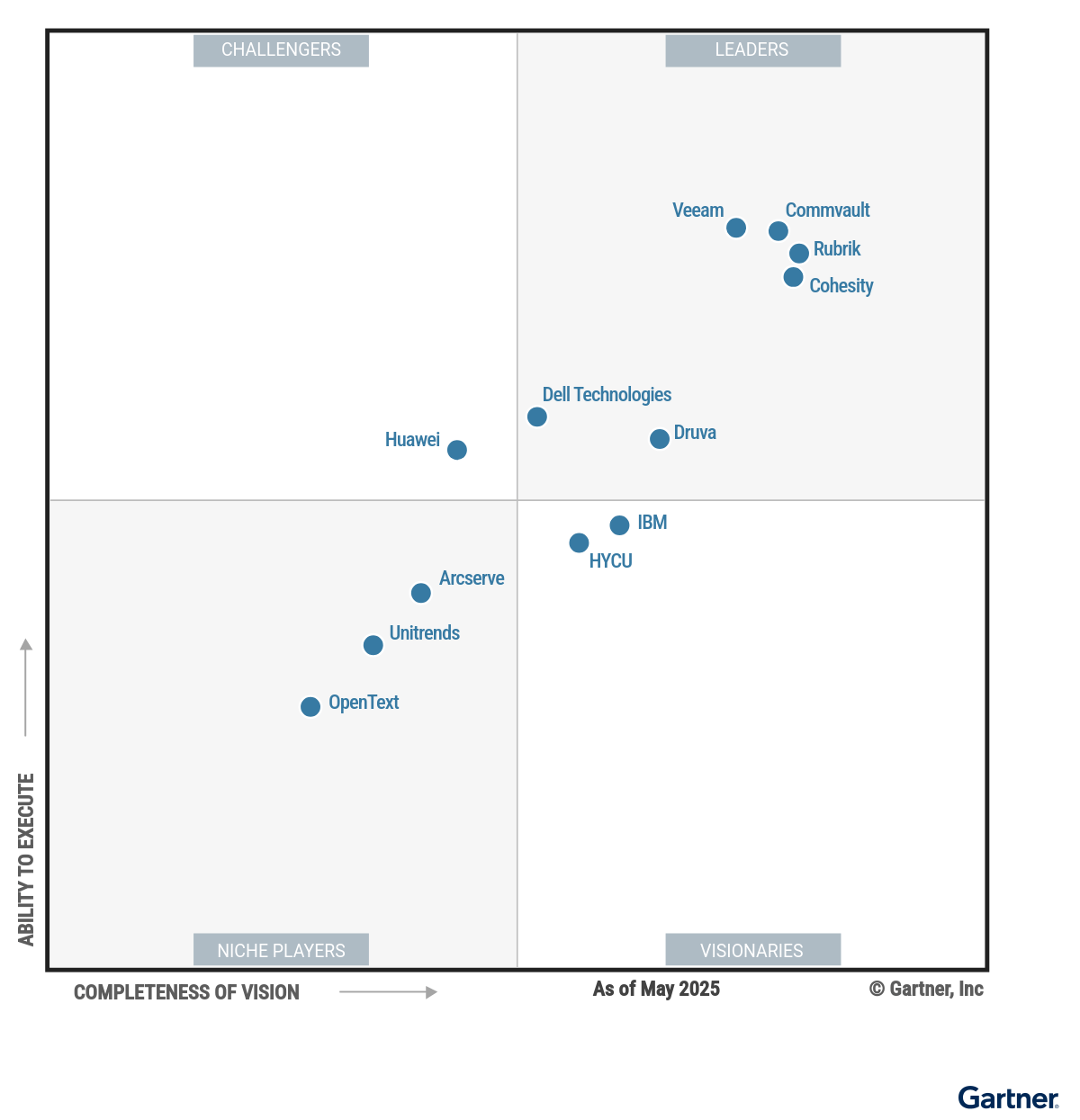
At its core, the Magic Quadrant evaluates vendors across two dimensions: Ability to Execute, which measures how well a vendor delivers today, and Completeness of Vision, which reflects how effectively a vendor anticipates and shapes future market needs. These dimensions create four categories: Leaders, Challengers, Visionaries, and Niche Players.
What the Magic Quadrant does not measure is just as important. It does not evaluate how well a platform is implemented, tested, or operated inside your specific environment. It cannot account for legacy systems, OT/IT convergence, plant-floor realities, or the discipline required to ensure recoverability in a real-world incident. Technology selection is strategic; resilience is operational.
Why the Magic Quadrant Matters to Manufacturing IT Strategy
Manufacturing environments operate under a different risk model than most corporate IT organizations. Downtime is not an inconvenience; it directly impacts production schedules, customer commitments, and revenue. Operational Technology and Information Technology systems coexist, often with decades of technical debt. Cyber insurance requirements are increasing, compliance standards are tightening, and internal IT teams are lean by necessity.
In this context, the Magic Quadrant helps leaders ask a better question: Which vendor strengths best align with our operational risk profile and recovery objectives?
Recent Gartner research around backup and data protection consistently emphasizes several themes:
- Ransomware recovery is now a primary buying driver.
- Immutability and backup verification are baseline requirements.
- Organizations must protect hybrid environments spanning on-prem, cloud, SaaS, and legacy systems.
- Vendors with mature operational platforms and broad workload support lead the market.
Veeam’s consistent placement in the Leaders quadrant reflects its strength in execution, platform coverage, and ransomware recovery capabilities. That leadership matters, but it becomes truly valuable only when paired with disciplined implementation and operational governance. Tools create potential; execution creates resilience.
From an executive perspective, understanding the Magic Quadrant enables better business outcomes. It supports faster, more defensible technology decisions. It strengthens cyber insurance posture. It reduces the financial and operational impact of incidents. Most importantly, it ensures that technology investments protect what matters most: continuity of operations.
Interpreting the Quadrants Through a Manufacturing Lens
Each quadrant represents different strengths that may align with different organizational needs.
Leaders are best suited for multi-plant operations, ERP-driven environments, and organizations with strict recovery time and recovery point objectives. They provide broad workload coverage and mature ransomware recovery capabilities.
Visionaries often introduce innovative architectures that appeal to manufacturers pursuing cloud modernization, automation, or edge computing. They require careful operational validation to ensure maturity matches ambition.
Challengers are well aligned for organizations prioritizing stability and predictable execution over aggressive architectural change.
Niche Players can be effective for specialized OT environments or regulatory-specific use cases, although they may lack scalability or broader platform depth.
The Magic Quadrant helps identify these strengths. It does not determine whether your organization can recover when production is down, and revenue is at risk. That outcome depends on execution.
Most recovery failures occur not because a platform lacked features, but because backups were never tested, immutability was misconfigured, recovery assumptions were never validated, or governance was inconsistent.
How Ozone and Veeam Together Turn Strategy into Resilience
Ozone IT Services uses Gartner’s Magic Quadrant as a strategic input, not a conclusion. It helps guide which technology partners are best positioned to support modern manufacturing environments. But Ozone’s real value is in translating research into results.
Ozone works with manufacturers to align vendor strengths to business risk, not marketing claims. It designs backup and recovery architectures that account for both IT and OT systems. It implements and manages Veeam-powered Backup-as-a-Service (BaaS) and Disaster Recovery-as-a-Service (DRaaS) solutions that are built for immutability, verification, and real-world recoverability. And it performs ongoing recovery testing, so clients know, with certainty, that their systems can be restored when it matters most.
In other words, Ozone turns strategy into operational resilience. Ozone works with manufacturers to:
- Align business risk to platform architecture
- Design OT-aware backup and recovery strategies
- Implement and manage Veeam-powered Backup-as-a-Service (BaaS) and Disaster Recovery-as-a-Service (DRaaS)
- Perform regular, verified recovery testing
- Deliver audit-ready reporting and governance
- Maintain operational readiness year-round
Veeam supplies the platform. Ozone ensures it works when your business depends on it.
As Marc Schwartz, Ozone’s Chief Technologist and Founder, states: “Our role isn’t to sell technology. It’s to put a solid IT foundation in place—reliable backups and strong cyber protection—so our clients can keep their businesses running without major disruptions.”
That partnership model bridges the gap between Gartner research and real-world outcomes.
Key Takeaways for Manufacturing Leaders
- Use the Magic Quadrant to shortlist vendors, not to finalize decisions.
- Define recovery objectives before evaluating platforms.
- Require real restore testing, not assumed recoverability.
- Measure total cost of failure, not just licensing costs.
- Choose partners who operationalize resilience, not just deploy tools.
If your organization relies on Veeam or is evaluating data protection platforms based on Gartner’s Magic Quadrant, the next step is ensuring your investment delivers real, verifiable resilience.
As a Veeam Certified Partner, Ozone IT Services helps manufacturers move beyond licensing to execution by designing, implementing, and operationalizing Veeam-powered BaaS and DRaaS solutions that are secure, tested, and audit-ready.
For Gartner’s full report, visit Gartner.com.
Resilience Ready
Learn how Ozone and Veeam together can strengthen your recovery posture, reduce downtime risk, and protect your operations with a resilience readiness assessment.
Contact Us.